
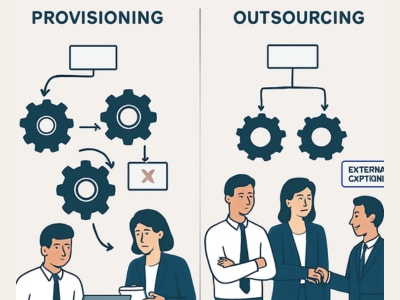
Provisioning is a critical operational step that connects sales, service delivery and billing. When provisioning workflows are inefficient, businesses experience delays in service activation, higher operational costs and customer dissatisfaction.
As companies grow and service volumes increase, provisioning processes often become complex and difficult to manage internally. This is why many organisations are now adopting outsourced provisioning services to overcome workflow challenges and improve operational efficiency.
Understanding Provisioning Workflows
A provisioning workflow refers to the sequence of activities required to move a confirmed order through configuration, activation and delivery. It ensures that a service or product is correctly set up and ready for customer use.
Typical provisioning workflow steps include:
Order validation and data entry
Service configuration
Resource allocation
System activation
Confirmation and handover to billing
When these steps are coordinated effectively, businesses achieve faster service delivery and improved customer satisfaction.
Billing Services Explained: A Complete Guide for Growing Businesses
Common Provisioning Workflow Challenges
1. Manual Processes and Operational Bottlenecks
Many organisations still rely on manual handoffs between departments. This increases the risk of delays, errors and missed activation steps.
2. Poor Visibility Across Systems
Disconnected systems make it difficult to track order status in real time. Without visibility, identifying delays or errors becomes challenging.
3. Data Inconsistencies
Incorrect or incomplete data flowing from sales to operations can cause activation failures or service delays.
4. Misalignment with Billing Processes
If provisioning and billing are not synchronised, customers may be billed before activation or services may go unbilled.
5. High-Volume Order Complexity
As businesses grow, managing increasing order volumes without structured workflows becomes difficult, leading to slower fulfilment times.
Provisioning services for order fulfilment and activation
How Outsourcing Improves Provisioning Efficiency
Outsourcing provisioning services introduces expertise, structured workflows and process optimisation that improve overall operational performance.
Standardised Processes
Outsourcing partners implement proven workflows that reduce inconsistencies and improve delivery speed.
Automation and Workflow Optimisation
Automated provisioning systems reduce manual effort, enabling faster service activation and fewer errors.
Improved Resource Allocation
Dedicated provisioning teams focus entirely on fulfilment tasks, ensuring faster turnaround times and better service quality.
Better Integration with Billing and Operations
Outsourced provisioning services often integrate smoothly with billing systems, reducing disputes and improving revenue accuracy.
Scalability and Flexibility
Outsourcing enables businesses to scale provisioning capacity without increasing internal headcount or infrastructure costs.
Operational Benefits of Outsourced Provisioning Services
Businesses that outsource provisioning commonly experience:
Faster order fulfilment
Reduced service activation delays
Improved operational efficiency
Lower error rates
Better customer satisfaction
Increased revenue accuracy
These benefits are especially valuable for telecom, managed service providers and other service-driven industries.
Why Sphere Global Solutions Supports Efficient Provisioning
Sphere Global Solutions delivers scalable provisioning outsourcing services designed to simplify complex workflows and improve operational performance.
Our approach includes:
Streamlined provisioning workflows
Reduced activation delays
Accurate data handling
Integration with billing and data entry services
Scalable delivery models for growing businesses
We help organisations improve efficiency while maintaining consistent service quality.
Conclusion
Provisioning workflow challenges are common as businesses expand, but they don’t have to slow growth. By outsourcing provisioning services, organisations can reduce operational friction, improve service activation speed and build efficient, scalable fulfilment operations.
Efficient provisioning is not just about internal productivity it directly impacts customer experience and revenue performance.
References & Sources
IBM – Service Provisioning Overview
https://www.ibm.com/topics/service-provisioningGartner – Order-to-Cash and Operational Efficiency
https://www.gartner.com/en/finance/topics/order-to-cashSalesforce – Order Fulfilment Process Explained
https://www.salesforce.com/uk/resources/articles/order-fulfillment/McKinsey – Operational Efficiency and Automation
https://www.mckinsey.com/capabilities/operations/our-insightsTM Forum – Telecom Provisioning and Service Activation
https://www.tmforum.org/resources/