
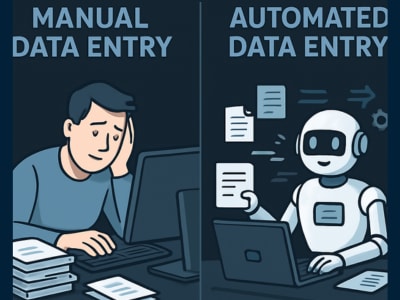
Every growing business eventually faces the same question: how should we manage increasing volumes of data? From invoices and CRM records to scanned documents and product listings, data entry is essential but the method you choose can directly impact cost, accuracy and efficiency.
Should you rely on manual data entry handled by trained professionals, or invest in automated data entry solutions powered by OCR and AI tools?
At Sphere Global Solutions, we support organisations with flexible data entry outsourcing services, helping them choose the right balance between manual expertise and automation. In this guide, we explore the advantages, limitations and ideal use cases of both approaches.
Understanding Manual Data Entry Services
Manual data entry services involve trained professionals entering, verifying and updating information within business systems such as databases, CRMs or accounting platforms.
Where Manual Data Entry Works Best
Manual entry is particularly suitable for:
- Handwritten forms
- Complex financial records
- Medical documentation
- Legal documents
- Unstructured or inconsistent data
Human judgement plays a critical role in these scenarios. A skilled data entry specialist can interpret unclear handwriting, identify anomalies and ensure contextual accuracy something automated systems may struggle with.
Advantages of Manual Data Entry
- Higher accuracy for complex records
- Better handling of unstructured information
- Human validation and quality checks
- Reduced risk of automated misinterpretation
However, manual data entry can be time-intensive, especially for high-volume projects.
Understanding Automated Data Entry Services
Automated data entry services use technologies such as Optical Character Recognition (OCR), Artificial Intelligence (AI) and workflow automation tools to extract and input data into systems.
Automation is often used in bulk data entry services, particularly where information is structured and repetitive.
Where Automated Data Entry Works Best
- Invoice processing at scale
- Standardised application forms
- Product catalogue uploads
- Data migration projects
- Large database updates
Automation increases processing speed and supports scalability, especially for businesses managing thousands of records daily.
Manual vs Automated Data Entry: A Practical Comparison
1. Accuracy
Manual data entry offers stronger contextual understanding, particularly for irregular or handwritten data.
Automation performs well with structured and consistent formats but may require human validation.
Best approach: Hybrid model combining automation with quality assurance.
2. Cost Efficiency
Automated data entry reduces labour costs for repetitive tasks. However, implementation requires technology investment and maintenance.
Manual data entry, especially when outsourced, can be cost-effective without upfront technology expenses.
3. Speed and Scalability
Automation processes large datasets quickly and consistently.
Manual entry scales through additional staffing but may take longer during peak demand.
4. Data Security and Compliance
Both models must follow secure workflows. Reputable data entry outsourcing providers ensure secure infrastructure, controlled access and GDPR-aligned processes regardless of method.
Why Many Businesses Choose a Hybrid Data Entry Model
Rather than choosing one method exclusively, many organisations adopt a hybrid solution:
- Automation handles high-volume, structured data
- Manual teams validate, correct and manage complex cases
This approach combines speed, accuracy and cost effectiveness while maintaining strong data quality management.
At Sphere Global Solutions, we design customised data entry solutions that align with each client’s operational needs and compliance requirements.
Choosing the Right Data Entry Solution for Your Business
When deciding between manual and automated data entry services, consider:
- Data volume and growth projections
- Complexity of information
- Compliance and confidentiality requirements
- Budget and operational flexibility
- Required turnaround time
For small to mid-sized businesses with complex records, manual outsourced data entry may offer better control and accuracy. For enterprises managing high-volume, structured data, automation supported by professional oversight may deliver stronger ROI.
How Sphere Global Solutions Supports Both Models
As a trusted BPO data entry services provider, Sphere Global Solutions offers:
- Professional manual data entry services
- Automated data processing solutions
- Secure document processing and digitisation
- CRM data management services
- Scalable bulk data entry support
- Multi-level quality assurance
Our flexible engagement models allow businesses to optimise performance without increasing operational risk.
Ready to Improve Accuracy and Reduce Costs?
If you’re unsure whether manual or automated data entry is right for your organisation, our experts can help.
Call Sphere Global Solutions today for a free consultation
Discover how secure, scalable and cost-effective data entry outsourcing can improve efficiency and protect your business-critical information.
Conclusion
There is no one size fits all solution when it comes to manual vs automated data entry services. The right choice depends on your data complexity, operational scale and strategic priorities.
With the right outsourcing partner, businesses can combine human expertise with automation to achieve reliable, secure and scalable data management.
Sphere Global Solutions helps organisations make that transition confidently.
References & Sources
- IBM – What is OCR and Data Automation
https://www.ibm.com/topics/optical-character-recognition - Gartner – Intelligent Automation Overview
https://www.gartner.com/en/information-technology/glossary/intelligent-automation - UK Information Commissioner’s Office (ICO) – Data Protection Guidance
https://ico.org.uk/for-organisations/uk-gdpr-guidance-and-resources/ - McKinsey – The Value of Automation in Operations
https://www.mckinsey.com/capabilities/operations/our-insights